
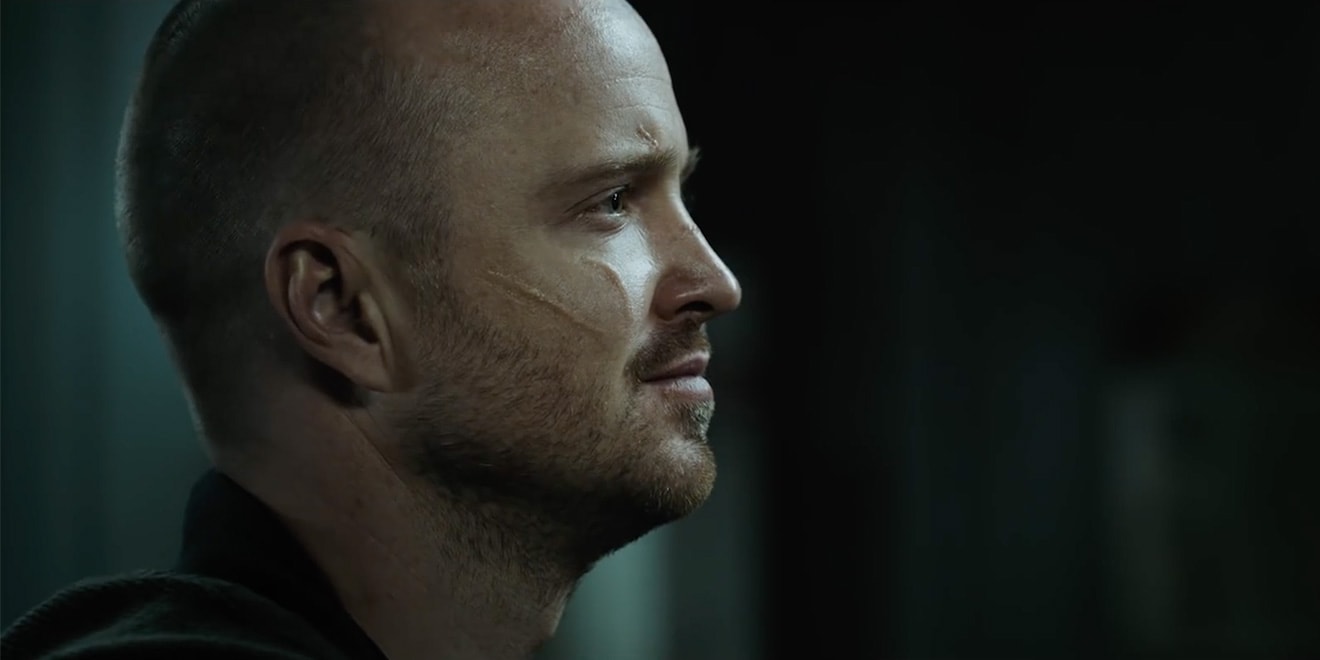
An impossible follow-up; El Camino precedes perhaps the greatest television series of all time. The slow-simmering world of Breaking Bad never really seemed like it would slot well into a 2-hour movie format, and El Camino proves that theory somewhat true. But it also carries all of the best features of that series – beautiful scene structure, lived-in characters and a desperate, beloved protagonist searching for something, and running from everything.
El Camino leads off right where Breaking Bad finished – with lovable loser Jesse Pinkman escaping his fascist cell and on the run. Ultimately it boils down to a fugitive film, with Jesse trying desperately to avoid the police and make it to Alaska on the advice of his old partner Mike Ehrmantraut.
Does it feel like much gets achieved in this film? Not quite. Unlike other directors, Vince Gilligan has proven that he feels no pressure to push along a story if it doesn’t feel right. This film doesn’t feature gratuitous callbacks to BB memories. It surprisingly does feature quite a few old favourites though, but they all feel relevant and carefully curated (even though Jesse Plemons looks and feels like an entirely different Todd). Perhaps the one omission that feels glaring is that of Saul Goodman. His relationship with Pinkman always felt like one worth exploring, and it might’ve been interesting to see the two – both presumably on the run and undercover – share the experience of being left in the wake of the great Heisenberg.
This film plays out more in vignettes than anything else, often in flashbacks. Ultimately, it really does feel like a TV-show structure contorted for Netflix viewing. That doesn’t make it unworkable, but it does feel somewhat oddly paced. The extended scenes between psychopath Todd and Jesse wouldn’t be allowed in another studio, but they are given room to breathe here.
Nonetheless, there are some sublime moments in this film. A moment between Jesse and a suspect cop where it’s clear Jesse has nothing to lose; a brief (shocking) moment where he has the upper hand on Todd; and a scarring moment where they ‘test’ the mechanics of his cage all stand out. They reveal what Gilligan and his team have always done better than anyone else – mould characters slowly in front of the viewers eyes so that their later actions feel genuine and earned. The earlier flashbacks to a young Pinkman are truly sad when contrasted with the older, wiser, tortured one and comprise its greatest moments. A brief, sweet encounter with old flame Jane might be the best, and even though she has only a few words, you can feel them swirling around in Jesse’s head. Of all the cameos here, hers is perhaps the most memorable.
There has always been something innately lovable about Aaron Paul’s character. Where Walter White was too cunning to ever truly let himself lose control, his accomplice was a different man. His tortured older self is sometimes difficult to watch here, and a late scene where he discusses his college prospects seem to hint at the different road he could’ve taken altogether. We want Jesse to get his life back on track. His interactions with his family, as they were in Breaking Bad, are just as heartbreaking here, and will be familiar to anyone who knows what it’s like to disappoint your parents and make them feel responsible.
If this truly is the end of Breaking Bad (which seems likely) this is a fitting way to end it. While Walter White was the captivating brain of that show, Jesse Pinkman was its heart. Where White was a tragic character destined to perish, it felt unfair that the younger Pinkman had been dragged unwillingly in his wake. El Camino gives him, and fans of that show, the closure they crave for a character who had earned it.
 THE MIDNIGHT SPECIAL