
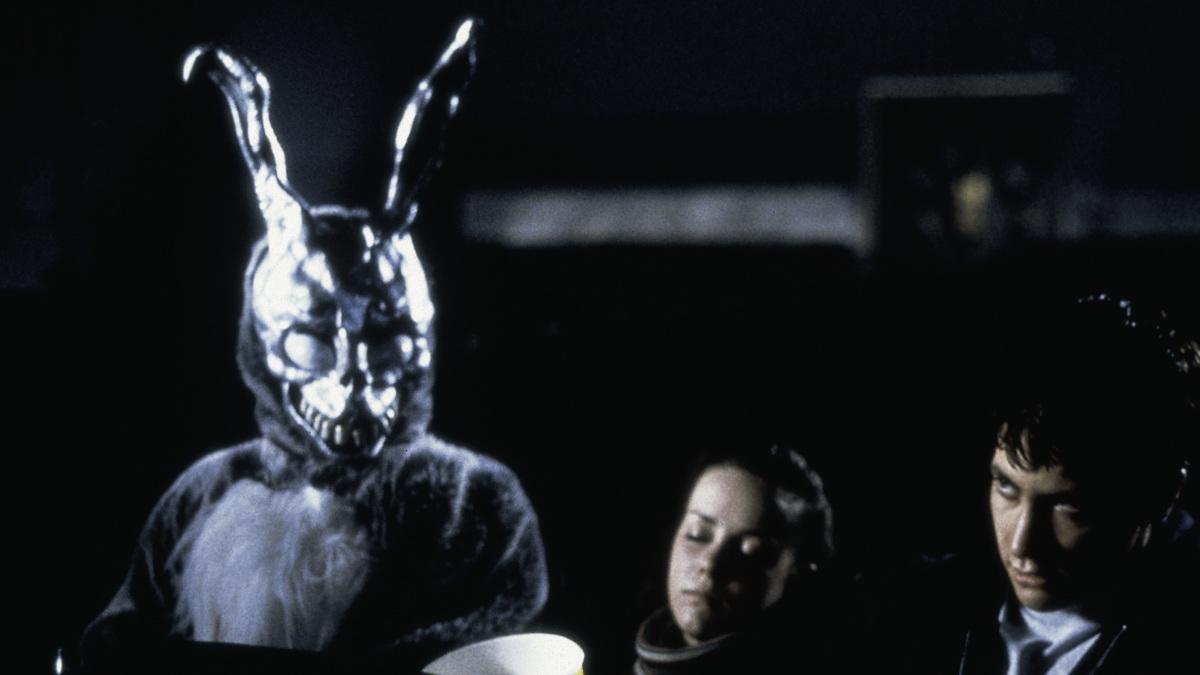
A deliberately strange film, it’s no surprise that Donnie Darko has become a certified cult classic. It features a knotty, occasionally nonsensical plot that demands multiple viewings, and a star-making performance from a young Jake Gyllenhaal. Films like this aren’t made anymore. Cinema is worse off for it.
Donnie Darko is an oddball film from beginning to end. We’re introduced to the titular character sleeping in the middle of a road, dazed and confused. The director, Richard Kelly, has the viewer’s attention immediately. He never lets up. By the end of the film, we’ve witnessed a plane jet engine crash into Darko’s bedroom, warped visual manifestations of the future, significant discourse on the concept of time travel and repeated visions of a demonic bunny rabbit.
Not much more need be said about this plot, because the film lives and dies on it. The great joy in this work is trying to piece together all the different, seemingly disconnected developments and jamming them together like melting jigsaw pieces. Who is the man in the red tracksuit? Why can’t anyone work out where the plane came from? What is Patrick Swayze doing here? Each time we think we’re close to solving a new equation, Kelly introduces another, even weirder one.
That leaves a story that is, in many ways, impenetrable. I am convinced that it cannot be completely followed, at least without referring to other source material and/ or DVD commentary. That is a failing of the film. But it is also part of its charm. We feel one step behind the precocious Darko, but that is somewhat by design because, well, he’s precocious. It’s more critical that the story remains gripping throughout, that we care about Darko, and that we know enough of the puzzle to work out something isn’t right.
A lot of credit goes to Gyllenhaal for making the character work. Darko could easily come across as obnoxious and petulant. Instead, he reverberates internal frustration. He’s trying to make sense of the nonsense being thrown at him, knowing he’s crazy but also that he’s seeing something purposeful. He runs the gamut of emotions. He’s also supported by a host of able secondary characters. In particular, Darko’s own family feel like real people caught in his orbit. One of the more unexpected scenes is when Donnie is disciplined at his school, and instead of his parents’ outrage once they discover what he’s done, they chuckle at the absurdity of it all. His sister, played by Maggie Gyllenhaal, is particularly fantastic herself. But his parents, played by Holmes Osbourne and Mary McDonnell, add real colour to what could have been an insufferably insular film.
Donnie Darko is not a perfect film. Repeated viewings, no matter how well-intended, won’t clarify some nagging questions in the plot. And any way it’s cut, that is an indictment on the film. But it doesn’t detract from an enjoyable cinematic experience. In present-day film, where every movie seems to be striving for clinical satisfaction, it’s refreshingly inaccessible.
 THE MIDNIGHT SPECIAL