
A faithful recreation of Shakespeare’s classic play, The Tragedy of Macbeth is an enjoyable (if inaccessible) lark championing the talents of Denzel Washington and Francis McDormand.
8.0
It’s not hard to see what might have driven Joel Coen to direct and distribute a cinematic interpretation of Macbeth. The plot, centered on a tortured, ambitious individual and his knifing wife is ripe for drama. The world has never been any more political. The concept of a man, driven to do things he would never dream of if it were not for the allures of power, is as apt as ever.
What might be a bit more surprising is that Coen steers desperately close to the original source material. This is literally the play being re-cast in cinematic form. It is not some abstract interpretation. No doubt another director could have taken some sort of fantastical, modern journey with the material, but there is something pleasing in such a faithful adaptation. As if to prove the enduring appeal of Shakespeare’s work.
The story of Macbeth is uncomplicated and forthright. Macbeth (Denzel Washington) and his lieutenant Banquo (Bertie Carvel) have just completed another conquest when they are suddenly greeted by a witch (a spellbinding Kathryn Hunter) promising that Macbeth will soon become Thane of Cordor and, eventually, King of Scotland. Neither Macbeth or Banquo appear persuaded by those words, until Macbeth suddenly does become Thane of Cordor in unlikely circumstances. His wife, Lady Macbeth (Frances McDormand) latches onto this sign and conjures a plan in her husband’s head to murder the king. Macbeth is at first reluctant, but slowly, deeply descends into her sway, all the while losing his grip on reality.
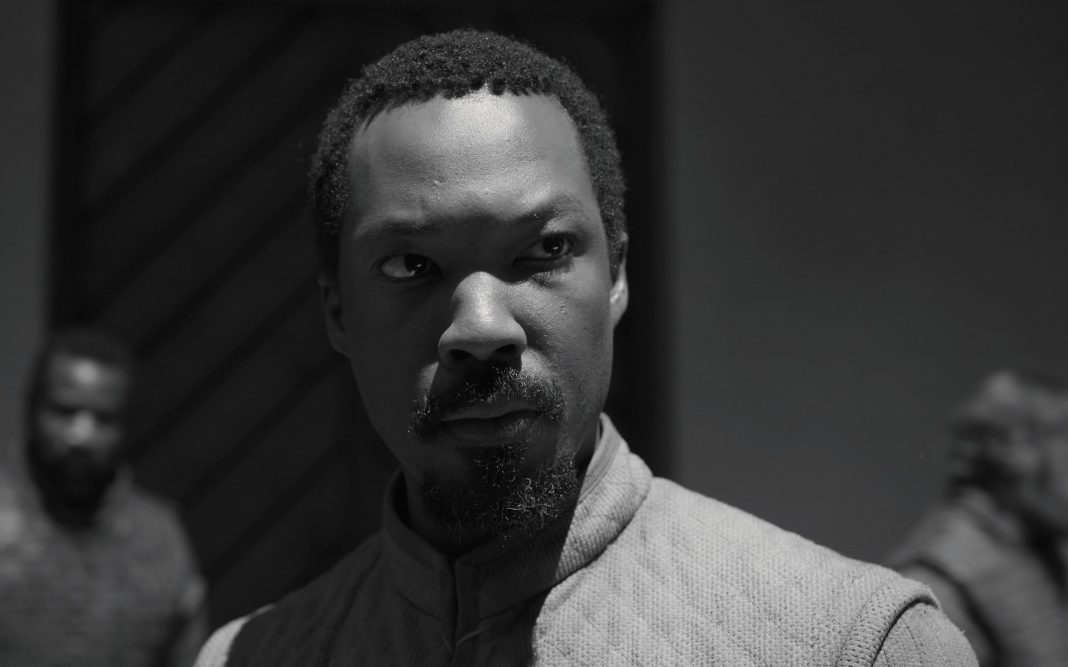
Coen makes a concerted effort to focus the viewer on Shakespeare’s language. Cleverly, the mise en scene is always sparse and uncluttered, everything dressed in a starc, gothic whitewash that gives the affair an otherworldy aura. Not only is that a good tonal choice, but it also helps direct our attention to the captivating soliloquoys of the characters. Notwithstanding it is difficult to get lost in parts – you probably haven’t had your ear tuned for knotty, old English language if you’ve only recently completed your third viewing of Spiderman: No Way Home.
Washington is the real star of this film, though. He imbues Macbeth with real volatility, not dissimilar to Detective Alonzo in Training Day. The swagger is there. He also carries a heaving physical presence. In earlier scenes, he presents as a dominant figure donned in chinking armour. But in the later throes, he lugs his weight around like a man tiring of his own conscience. Washington’s inherent charm and charisma almost shine through against their will. He delivers his monologues with real belief and earthiness and that marbling Denzel cadence, as if you could hear him in his study in the present-day and hardly blink.
McDormand is enchanting as Lady Macbeth working her ways on her husband, even if she is outshone by the scene-hogging Washington. Hunter leaps fully into her role and was right to do so. She adds immeasurably to the play’s omniscience and her croaky enchantments will likely haunt you for some time. And one of the more pleasant surprises is the performance of Corey Hawkins as Macduff, particularly in a late scene where he remarks at Macbeth’s callous willingness to murder children when he has none of his own.
If you are looking for a modern, accessible adaptation of this classic play, look elsewhere. The Tragedy of Macbeth will only leave you frustrated and will probably ruin your night at home on the couch and you will curse it for making you strain your eyes and ears. Approach it openly, with an understanding that some parts will wash over, and revel in its skeletal imagery.
 THE MIDNIGHT SPECIAL