
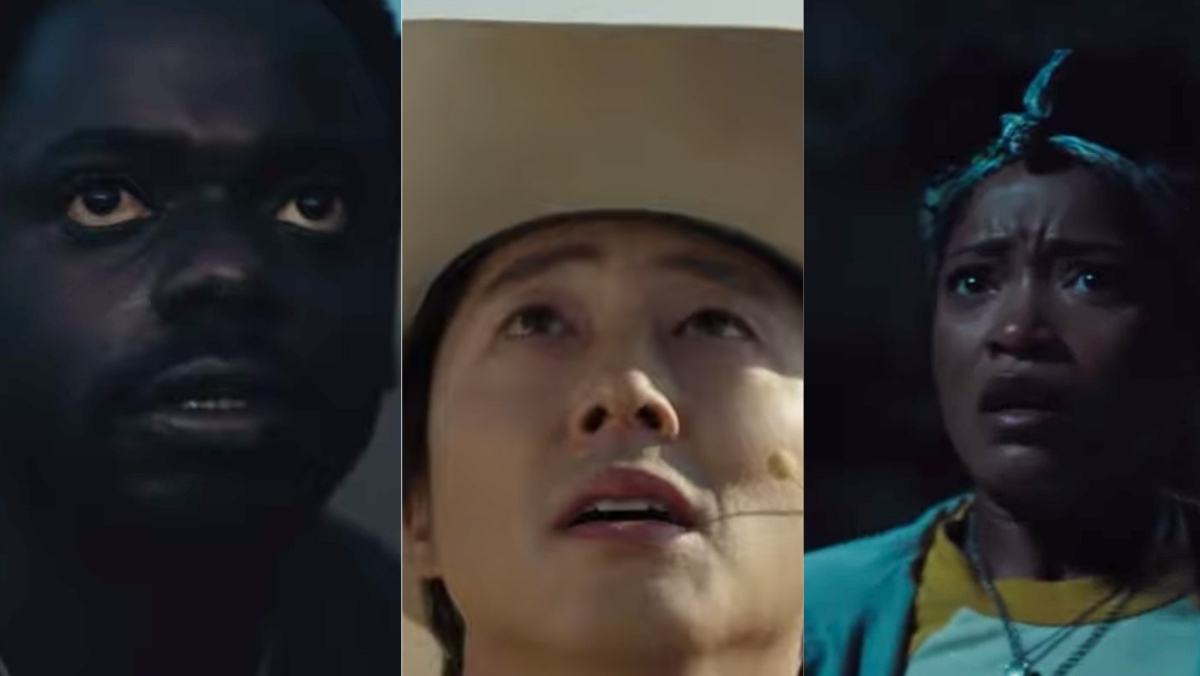
Jordan Peele’s weirdest and least accessible film yet, Nope is still utterly enthralling till its satisfying end.
8.5
A shot, at a child’s height, of a CGI ape stammering around what appears to be a TV set covered in blood. The bottom half of a body visible. Silence save for the ape’s distressed panting. If you know anything of Jordan Peele, you won’t be surprised to learn that it takes a very long time for this opening scene in Nope to make any sense. In fact, you might still be unsure after it ends.
After this shot, Peele transports us to an entirely different locale. We’re left watching Daniel Kaluuya’s “OJ” (Otis) on barren land training horses with his father. Suddenly something very strange happens to his father. OJ rushes him to hospital but its for nought. Apparently a coin fell out of the sky and impaled him. From a private jet perhaps.
It turns out that OJ’s family, which includes his sister Emerald (played by the electric Keke Palmer), are descendants of the first Black Hollywood horse-wranglers. Business is not great, and OJ seems like the only one interested in keeping the business going even if he himself is resigned to making a loss.
Things get much, much weirder from there. Soon we meet Jupe (Steven Yeun), who is a confusing figure himself and feels plucked out of another place and time. A local peroxided store clerk (Brandon Perea) falls into the loop, and there’s one other player that has to be seen to be believed. Later on, a strange Hollywood director (Michael Wincott) enters the fold. The rest is better left unsaid.
This is a Peele movie, so there’s an inescapable feeling that every shot, image and object has four layers of meaning. Peele knows this and that he’s throwing a lot at the screen. So the film starts slowly and gives the viewer a chance to make sense of the place and start to piece things together without too much friction.
Even still, it’s difficult to keep track of things and your enjoyment will depend on whether that intrigues or frustrates you. Yeun’s character in particular seems to throw the mind off course a bit. It’s hard to get a handle on his role in the piece.
Nope also ‘suffers’ from another problem. Once it gets going, the mechanics of its plot take over and become much more interesting than any double meanings in a horse statute or a Wacky Wavy Inflatable Arm-Flailing Tube Man. The villain of this film is inspired and just downright weird. What’s amazing is how comfortable Peele is with exposing it. By the end of the film there’s nothing left to the imagination. But a significant part of the fun of this film is watching the characters (particularly Kaluuya, who plays OJ as anxious, mopey and jaded) trying to work out how to overcome it. There are a couple of truly brilliant scenes in the middle of the film that pipe up the tension and the final confrontation is shot expertly, cutting between action points and playing with the motif of videography itself. Peele has proven a genius at executing a climax.
Is Nope better than Get Out or Us? Probably not. It’s more interested in abstract meaning than either of those two films and perhaps in the process gets in its own way in the same way that Us felt like it almost did. It asks a lot of the viewer. There’s references to race, auteurship, the symbolism of horses, and the symbolism of the ‘figure’ itself. For some, it’ll be too much. It’s almost impossible to digest during its run-time.
But this is what you get with an auteur – a true spectacle. Nope runs for 2 hours and 15 minutes and is never anything less than enthralling. It’s characters are well-developed and likable. Kaluuya is brilliant and resists the temptation to overdo the stoicism. It’s sense of place is inspired. How many films have you seen executed almost entirely in the desert. How many horror movies have you seen where key set pieces take place in broad daylight? You won’t see another film like this and you may not have wanted to see this type of film, but you won’t be able to look away.
 THE MIDNIGHT SPECIAL