
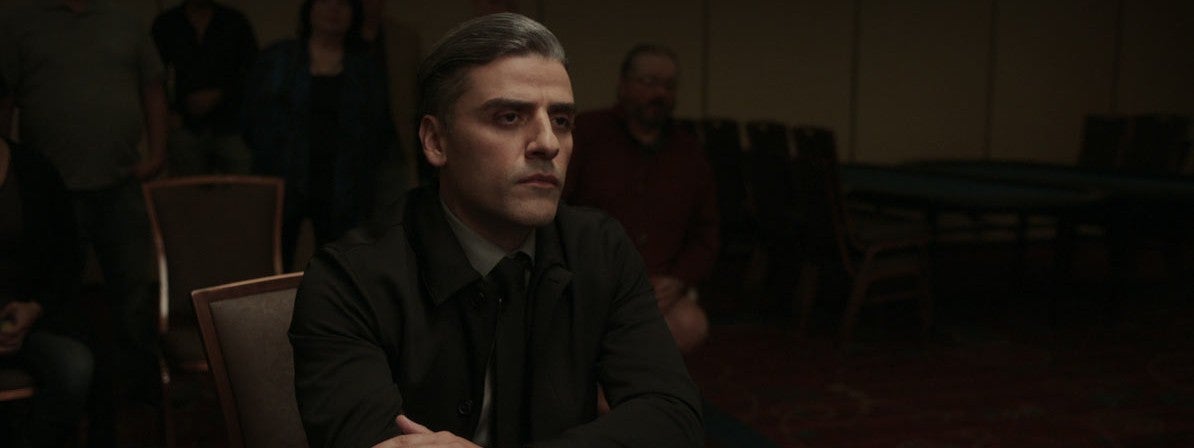
Paul Schrader, legendary writer/director, mines a topic he knows well in The Card Counter – that of the brooding, disaffected male loner. His muse this time – Oscar Isaac. Their minds meld in this slow-cooked thriller. But true to Schrader’s form, it cooks very slowly. It needs a kick of something.
7.8
Isaac plays “William Tell”, although it’s not always clear what his name really is. Tell is a casino-hopping card-player. The early setup in this film is done with efficiency and style. We see how his mind analyses a blackjack table with the calculated mind of a veteran. We also see how it’s good to win but not too big to garner attention. We get a sense of Tell’s work, and a more general sense that he’s quite happy to do it alone.
Two figures start to shift his views. The first is Cirk (“Cirk with a C”), played by Tye Sheridan. They cross paths somewhat fortuitously while watching a talk by former security officer Major John Gordo (played by Willem Dafoe), and over a late-night drink the plot’s wheels start to churn and clink. It turns out that Major Gordo used to boss around Cirk’s father, leading the father to beat the other family members and to the end of his life. It turns out Tell has quite a past with Gordo, too. We learn about that in one of the film’s more electric scenes.
The second figure is La Linda (Tiffany Haddish). Linda is something of a backer. She backs card-players at tournaments. If they win, she gets a cut. She becomes interested in adding Tell to her “stable”. Tell is initially reticent, but he slows shifts.
One thing you may notice about The Card Counter is its similarities to Taxi Driver; that classic penned by Schrader. Both feature a brooding male character in the centre, so tormented by themselves that they’ve folded almost entirely inward. Isaac is excellent in the role. A role like this can quickly become something of a caricature. But Isaac gives Tell an underlying warmth, even if he has difficulty projecting it. And while Tell has its own quirks, they feel less like movie signposts saying “look how weird I am” and more like genuine afflictions. Isaac also possesses an intense, believable physicality. In a later scene, he harnesses the rage of a troubled past and you don’t doubt it for a moment.
But the film languishes a bit. It is mostly comprised of the trio of Tell, Cirk and Linda hopping from small-time casino to small-time casino in different states. They generally project as grim locales. Schrader also deliberately seems to hide a lot from view. The card-playing takes a backseat after that exciting introduction, and while the film has a deep undercut of visceral violence, we oddly never really see it. You sense Schrader wants to guide the audience to his message, and that’s fine, but the film doesn’t peak and valley in a satisfying way. And the ending, quite deliberately, leaves a dissatisfying taste in your mouth. Taxi Driver indeed.
But Taxi Driver’s Travis Bickle was a thrilling character and posed a thrilling character study. He had moments of electricity. Isaac’s Tell, with his sunken eyes and hollow soul, bears none of that. Set under the dark lights of colourless casinos, The Card Counter can sometimes feel a bit static. Haddish is an interesting counterpoint and an inspired bit of casting, but she feels lifted from an entirely different film, and the chemistry between her and Isaac feels more strange than energetic. It feels like the first choice for the role was already booked.
The beauty of Schrader’s work is how he strips back the elements of film to their core. It is done well in The Card Counter, but it might have helped to add a bit of padding. The characters, plot and setting are all so lean. There’s very little to grip onto. It leads to a film that can become distractingly bare. Like a casino parking lot.

