
A biopic that resists adoration, and is better for it.
Biopics abound. For what? So many attempts have been atrocious.
Director Matt Johnson seems to understand this. Unlike perhaps any other biopic, Tony does not follow its subject for its subject’s sake. Rather, it’s a visceral, confident portrait of an anxious, mendacious lout desperate to be taken seriously, and likely one with only a scant resemblance to Anthony Bourdain. It succeeds in spite of being, by most measures, a failed biopic.
Tony centres on a few chapters from Bourdain’s undeniable Kitchen Confidential, in which he recounts a formative summer in Provincetown, Massachusetts. Then a burgeoning self-serious student writer, he travels there to follow a girl after being crushingly rejected for a writing fellowship from Vassar College. He’s fresh off being told he’s not as clever as everyone needs to think he is.
But the scenes before we arrive in the seaside town are some of the better ones.
One scene – that first meeting between Bourdain (Dominic Sessa) and the girl, Cary (Emilia Jones) – is a highlight. Johnson establishes a sort of superficial confidence to Bourdain – confident enough to leave his drinking buddy and approach a girl in a bar, but not quite confident enough or sufficiently self-knowing maintain the facade after being challenged. He’s full of long words and self-importance, but hasn’t worked out the difference between charisma and insolence. Cary laughs him off but tells him to visit her in Provincetown if he’d like. This is a scene that, despite not being in the book and there being no reason to really believe it took place, feels very true to what a young Bourdain might’ve been. Charming, if not a bit obnoxious. Not the finished article.
Another scene involves Bourdain and his family. There is a tense family dinner. The dynamics are clear. Bourdain’s father has little understanding of his son, tentatively hoping he’s on the straight-and-narrow at Vassar but with the sort of knowing glances that suggest he’d in fact rather not know. But Bourdain’s mother, played with an austere glaze by Dagmara Dominczyk, seems to be looking right into her son’s psyche. She’s an effective patroniser. We learn that she is the only person who calls him ‘Anthony’. The film sees importance in that.
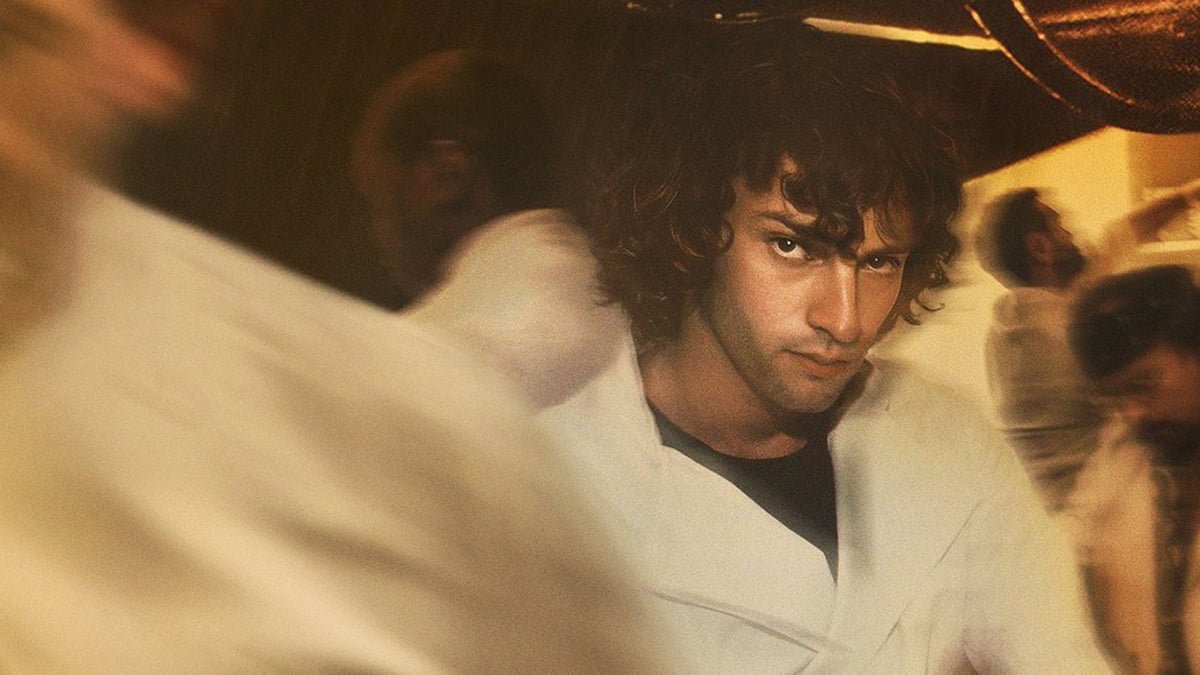
But it crackles when we arrive in Provincetown. Bourdain sulks around the promenade as the town tinkers between blaring sunshine and gloomy cloud, and Sessa uses his lurching posture and stilted gait to great effect. Soon, and after humiliating himself at a beachside restaurant, he’s crashing on the porch of a mysterious chef (Antonio Banderas), becoming fast friends with the exceptionally volatile Sal (Leo Woodall), and washing dishes for the privilege. Intermittently, he’s stalking Cary.
Tony then settles into a very pleasant hum. We watch Bourdain fumble around the kitchen and spend time under the arm of Sal. Woodall starts off with a concerning accent but he settles in quickly and almost steals the film. He conveys a real darkness without being theatrically dichotomous, and neither he nor the film try to gloss him with trite ‘complexity’. Banderas is also quite effective and believable as the sanguine head chef. Jones fares worse, not being given a great deal to chew on and feeling like she pops in and out of the plot at its convenience.
Despite the performances, none of these characters quite come into their own because they are all more so symbols for Tony than actual people. Johnson does this intentionally. I was left longing for something a bit more organic, rather than such an overt bildungsroman.
But Tony himself is a captivating draw. Sessa plays him with that delicate balance of arrogance and deep insecurity. He thinks he’s better than everyone but he’s very concerned as to why no one else agrees. He is a prolific liar; at numerous intervals the film expertly lulls the viewer into believing Bourdain is about to redeem himself with the truth but it pulls back each time. These parts, done very well, feel true to Bourdain. The kitchen is also used to humble Bourdain, instead of mythologising him. Johnson resists the urge to sanitise his subject, and it’s never suggested that he was some sort of prodigious star-in-the-making in the kitchen. The film pays that no attention.
Does it suffer from a few too many matters of convenience? Yes. Near the end, it feels very much like a movie and less like a character study, hitting familiar A24 executive-approved beats. It loses a lot of its well-earned grittiness and angst, especially after Woodall takes a back seat. A late catastrophe in the kitchen feels particularly rote.
But the conclusion has an undeniable satisfaction because Johnson and Sessa come together on what the film is about – Tony becoming Anthony. It calls back to the early scenes between Bourdain and his mother, and those scenes then turn a different colour. The end product is a very satisfying film with a real pulse. A biopic disinterested in accuracy and better for it.

